

Ever received a friend request from a stranger who claims to know your squad? Or agreed to sell a rare in-game item to someone whose story felt slightly off? A people finder gives you a quick way to check whether a name, place, or contact detail lines up with a real person before you commit to anything. This guide walks through how to use the People Finder on FreePeopleSearch.com, what the results really tell you, and why the habit is useful for anyone who spends time in online gaming communities.
What the People Finder Actually Does
The People Finder is a lookup tool that searches by name and location. You type in a first and last name, add a city or state, and press Search. The site then scans public records and other online data sources to build a free report. According to the site’s own description, that report can include phone numbers, email addresses, address history, social media details, and possible relatives.
The records behind those reports come from places such as court filings, marriage records, civil cases, liens, and bankruptcies. Basic searches are free, while a fuller report is offered as a paid upgrade. That split matters, and we come back to it later in this guide.
Quick Facts at a Glance
| Feature | What to Expect |
|---|---|
| Search inputs | Full name plus city or state |
| Base cost | Free for basic results |
| Deeper reports | Available for purchase |
| Typical data points | Phones, emails, past addresses, possible relatives, social profiles |
| Data origin | Public records and online sources |
| Regulatory status | Not a consumer reporting agency under the FCRA, per the site |
Get Your Details Ready Before You Search
A good search starts before you open the page. Results are only as useful as the information you feed in, and common names can bury the person you want under dozens of look-alikes.
What to Collect First
Write down everything you know about the person, then rank it by how reliable it is. A full legal name beats a gamertag, and a confirmed city beats a guess.
| Detail | Why It Helps | Reliability |
|---|---|---|
| Full name spelling | Narrows the match list | High if you saw it on a document or invoice |
| City and state | Separates people who share a name | Medium, since people move |
| Old or new phone number | Helps confirm a match later | Medium |
| Email address | Useful for cross-checking | Medium |
| Username or gamertag | Not searchable here, but useful for context | Low on its own |
A Note on Nicknames
The People Finder works from real names, not handles. If the only thing you have is a gamer tag, the tool cannot help much. In that case, ask the person for a legal name only if the situation truly calls for it, such as a paid trade or a meet-up.
How to Run Your First Search
The process takes only a couple of minutes. Follow the order below and you will avoid most beginner slip-ups.
- Open the FreePeopleSearch.com home page and find the search bar at the top.
- Type the first and last name exactly as you know them.
- Add a city or a state. If you are unsure, start with the state and tighten it later.
- Press Search and wait while the site scans its sources.
- Review the list of matches, comparing age range, locations, and relatives against what you already know.
- Open the most likely profile and read the free summary.
- Decide whether the free data answers your question. Pay for a full report only if it does not.
Tips That Save Time
Try the middle initial if a name is common. Search a second spelling if nothing appears, since records often contain typos. If you get too many hits, add a city rather than guessing an age. And write down what you find, because the same search on another day can list results in a different order.
Reading the Results Without Getting Misled
A result page looks official, but it is a starting point, not a verdict. The Federal Trade Commission has been blunt about this for years. In its case against the background report companies TruthFinder and Instant Checkmate, which ended in a $5.8 million penalty, the agency said the firms advertised highly accurate information while pulling data from third parties that disclaimed accuracy. People search data is stitched together from many places, and stitching leaves gaps.
Match Signals and Warning Signs
| What You See | What It Suggests | What to Do |
|---|---|---|
| Name, city, and age range all fit | Likely the right person | Cross-check one more detail |
| Right name but wrong state | Possible relative or a namesake | Compare relatives listed |
| Old phone number only | Outdated record | Treat as history, not proof |
| Several near-identical profiles | Duplicate or merged records | Open each and compare |
| Data that contradicts what you were told | Either an error or a false story | Verify through a second source |
The Two-Source Rule
Never rely on one page for a decision that costs money or safety. Confirm at least one detail somewhere else, such as a public social profile, a business listing, or a mutual contact who can vouch for the person. If two independent sources agree, your confidence rises. If they clash, slow down.
Free Report or Paid Report: Which One Fits?
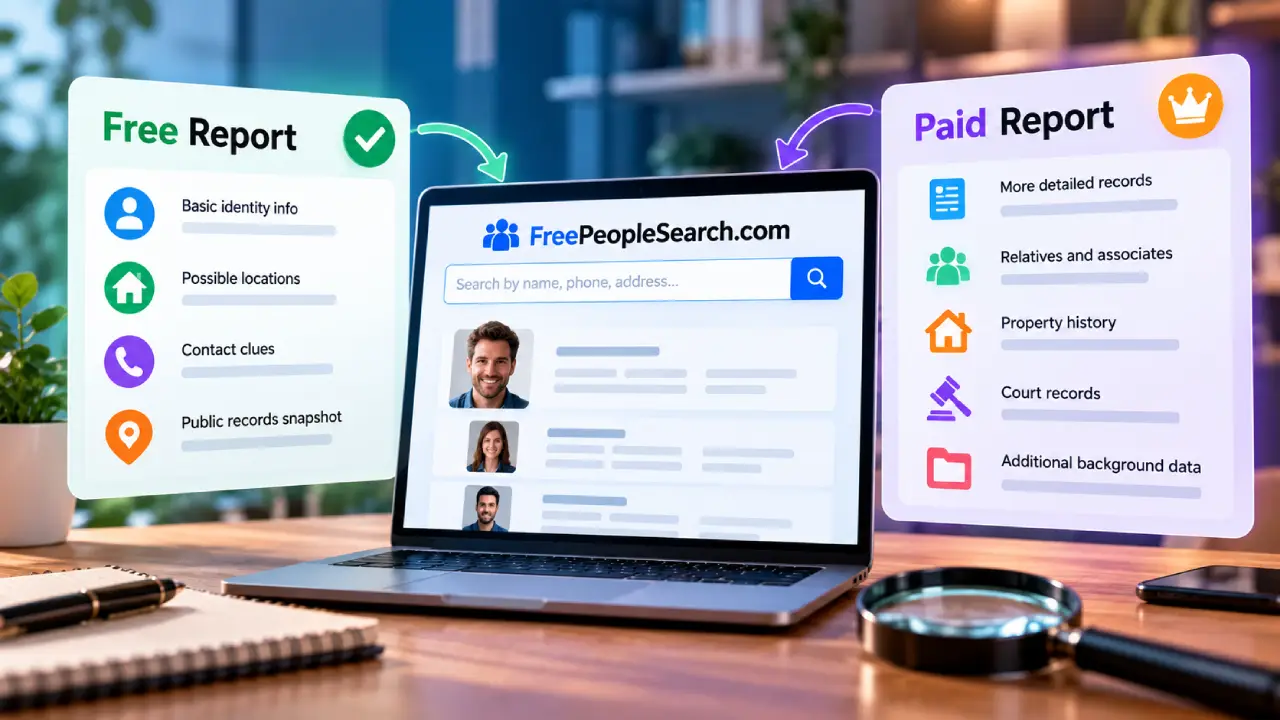
Most people never need to spend anything. The free tier is designed for a quick sanity check, while the paid tier goes deeper for situations with more at stake.
| Situation | Free Search Enough? | Reason |
|---|---|---|
| Checking if a name matches a location | Usually yes | Basic identity signals are shown |
| Confirming a seller before a small trade | Usually yes | You only need a consistency check |
| Reconnecting with an old teammate | Often yes | Contact clues may appear in the summary |
| Verifying someone before a large payment | Maybe not | Deeper history could help, but treat it with caution |
| Anything tied to hiring, renting, or credit | No | These uses need a regulated screening service |
That last row deserves attention. FreePeopleSearch.com states plainly that it is not a consumer reporting agency under the Fair Credit Reporting Act. The FTC has taken action against people search companies that marketed reports for tenant and employee screening while ignoring the law’s accuracy and permissible purpose rules. In short, use this tool for personal, informal checks, and use a regulated provider for formal decisions.
Why This Is Useful for Players
Gaming communities run on trust. You trade items, join private servers, split costs on subscriptions, and sometimes meet teammates in person at events. That trust is exactly what scammers look for.
The Bigger Fraud Picture
The numbers explain why a quick check is worth the effort. In testimony to Congress, the FTC reported that consumers lost $15.9 billion to fraud in 2025, up from just over $12 billion the year before, and warned that the true cost is far higher because most incidents go unreported. The same statement named social media as the top contact method by total reported losses, at over $2 billion in fiscal year 2025. Reports collected from FTC data and summarized by NordVPN show more than 55,500 Americans reported romance scams in the first three quarters of 2025, with about $1.16 billion lost and a median loss near $2,050. Online friendships that grow inside games and chat apps fit the same pattern.
Where a Quick Lookup Helps
| Player Scenario | What the People Finder Can Confirm | Benefit |
|---|---|---|
| Buying an account or rare item from a stranger | Whether the seller’s name and region are consistent | Fewer fake sellers |
| Meeting a teammate at an event | That the person is who they said they are | Safer meetups |
| Joining a new clan or guild with a real-name admin | That the leader exists and matches their story | Less impersonation |
| A friend asks for money urgently | Whether the details they gave add up | Protection against romance and emergency scams |
| Finding an old squad member | Possible current city or contact clue | Easier reunions |
| Checking your own exposure | What strangers can see about you | Better privacy choices |
Why That Helps Beyond Safety
A lookup also lowers stress. Instead of wondering, you can check in a few minutes and move on. It gives you a factual reason to say no when something feels wrong, which is easier than arguing about a gut feeling. And it helps you see your own footprint, so you can decide whether to share less on public profiles.
Privacy, Legal Limits, and Responsible Use
A tool that finds people can also hurt people. FreePeopleSearch.com prohibits using its service to stalk or harass individuals or to steal an identity, and you should treat those limits as the floor, not the ceiling. Look someone up to verify a claim or reconnect, then stop. Do not contact people who have not invited it, do not share what you find in a public chat, and do not turn up at an address.
Do and Don’t
| Do | Don’t |
|---|---|
| Check a name against a story you were told | Use results to pressure or threaten anyone |
| Keep findings private | Post someone’s address or phone in a group |
| Verify with a second source | Treat one report as proof |
| Use a regulated service for hiring or renting | Screen employees or tenants with a people search |
Checking and Removing Your Own Listing
Run your own name through the tool first. Then think about removal. Privacy Guides notes that hundreds of people search sites exist, yet most are run by a small handful of companies, so opting out of the major ones covers a lot of ground. It suggests working through one site a week and repeating the round every quarter, since removed data tends to reappear. The FTC also cautions that opt-out buttons do not always work as promised. In the TruthFinder and Instant Checkmate case, the agency found that a Remove button only hid an item from one report instead of every search. On FreePeopleSearch.com, the footer links to privacy rights and a Do Not Sell or Share My Personal Information page, which is the place to begin.
Keep in mind the irony that a removal request usually asks you to hand over some personal details. That trade is normally worth it, but use a dedicated email address for the process.
Mistakes to Avoid
| Mistake | Better Habit |
|---|---|
| Searching only a first name and a state | Add a full last name and a city |
| Trusting the first match | Compare age, place, and relatives |
| Paying before reading the free summary | Check what is already shown |
| Using results for hiring or renting | Choose a regulated screening provider |
| Ignoring your own record | Search yourself every few months |
Frequently Asked Questions
Is the People Finder really free?
Basic searches are free. The site offers more detailed reports for a fee, so expect an upgrade prompt.
Can I search by gamertag or username?
No. The tool is built around real names and locations, so a handle alone will not return a useful match.
Are the results always correct?
No. Data comes from many public and online sources and can be old, duplicated, or wrong. Verify anything important with a second source.
Can I use it to screen a tenant or an employee?
No. The site says it is not a consumer reporting agency under the FCRA, so it is not meant for those decisions.
How do I get my own information removed?
Start with the privacy links in the site footer, then repeat the process on other major people search sites and recheck every few months.
What to Remember
The People Finder on FreePeopleSearch.com works best as a fast, low-cost reality check. Prepare accurate details, run a focused search, read the results with healthy doubt, and confirm anything important elsewhere. For players, that small routine can mean the difference between a good trade and a lost account, or between a friendly meetup and an unpleasant surprise. Use it with respect for the people behind the names, and your own privacy will be easier to protect as well.